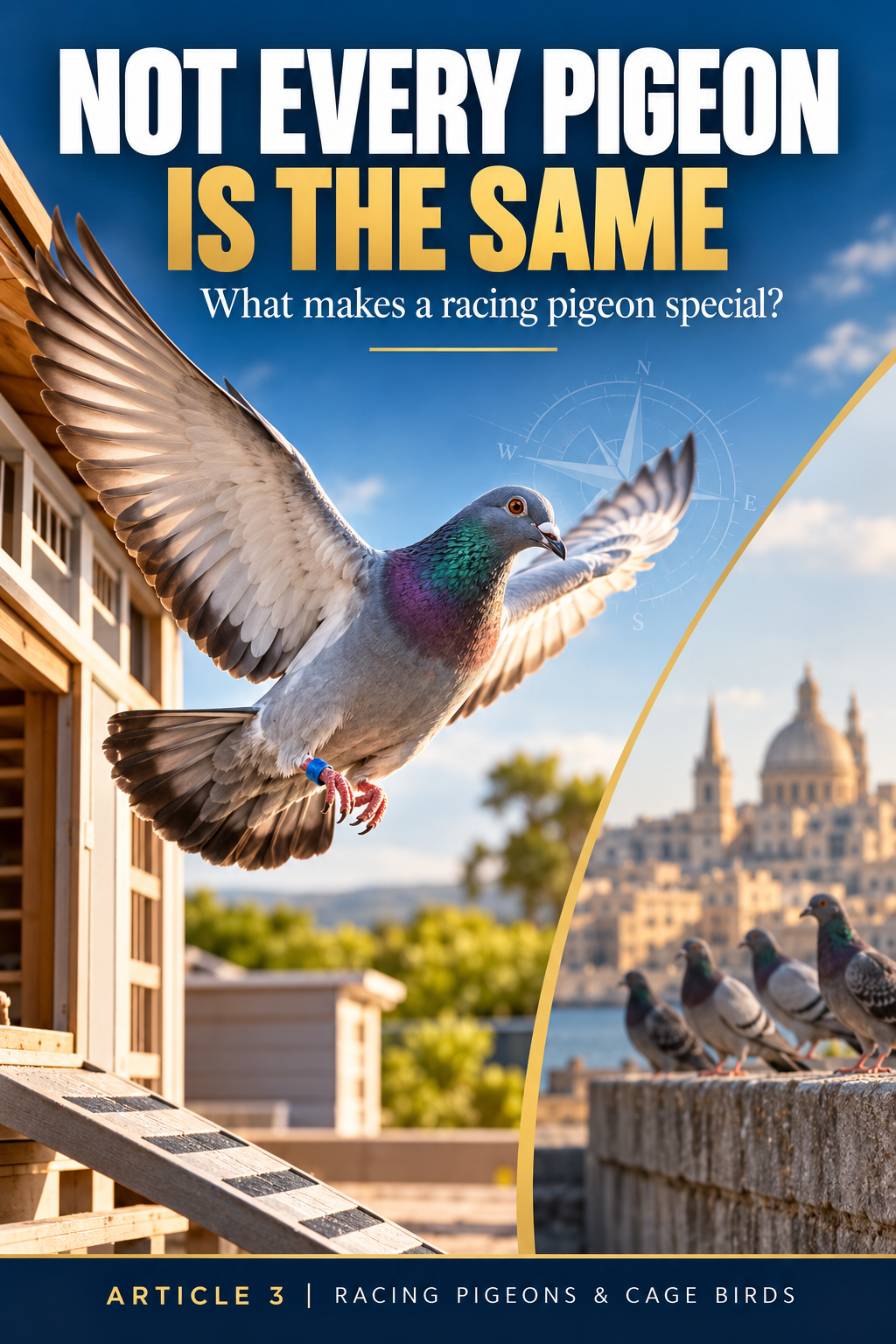
When many people see pigeons in towns, they naturally assume that all pigeons are the same. They may ask: “What is the difference between a racing pigeon and a normal pigeon?”
It is an important question. Racing pigeons are often confused with feral pigeons living around buildings and public places. Although they are related, they are very different in their breeding, lifestyle, purpose, care and relationship with people.
What is a racing pigeon?
A racing pigeon is a domestically bred pigeon selected over many generations for its natural ability to return to its own loft.
It is not simply a pigeon that has been taken outside and released. Racing pigeons come from carefully developed families and bloodlines. Breeders select birds with qualities such as intelligence, memory, navigation, homing ability, endurance, speed, physical strength and determination.
Every racing pigeon has its own identity, breeding background and registered ring number. It belongs to a particular loft and has been bred and prepared for a specific purpose.
What makes a racing pigeon special?
The most remarkable quality of a racing pigeon is its ability to find its way home. After being transported away from its loft, it can use its natural senses and environmental information to work out its direction and return to the place it recognises as home.
Scientists believe that pigeons use a combination of abilities to navigate. These may include visual landmarks, memory of landscapes, smell and environmental information, the position of the sun and the Earth’s magnetic field.
Navigation is complex and is not based on only one ability. What makes the racing pigeon special is the combination of intelligence, memory, orientation and determination.
The racing pigeon is not simply a fast bird. It is an intelligent navigator with memory, learning ability and a powerful attachment to home.
Why are not all pigeons the same?
All pigeons may look similar to someone who is not familiar with them, but they can be very different in their qualities and purpose.
This is similar to dogs. Dogs belong to the same animal family, but a racing greyhound, a guide dog and a small companion dog have very different abilities and roles.
The same applies to pigeons. Some are bred for racing, some for showing, colour, body shape, special features, tumbling or companionship. Racing pigeons are selected specifically for performance, homing ability and endurance.
Two pigeons may look almost identical, but one may have the ability to navigate and perform over long distances while the other has never been bred or prepared for racing.
Racing pigeons and feral pigeons
A feral pigeon lives independently in towns, buildings and public areas. It normally finds its own food and shelter and does not belong to an identified loft or owner.
A racing pigeon is different because it:
- Belongs to a registered loft
- Has an identification ring
- Has a known owner
- Comes from selected breeding lines
- Receives regular care and management
- Is trained gradually
- Has a specific home to which it returns
- Takes part in an organised sport
Feral pigeons and racing pigeons are related, but they do not live the same way or serve the same purpose. It is important not to judge one by the other.
A pigeon seen in a town represents urban wildlife. A racing pigeon represents a managed breeding programme, a loft, a sport and many years of knowledge and dedication.
Why racing pigeon enthusiasts are different
Racing pigeon enthusiasts are not simply people who keep pigeons around their homes. They are breeders, trainers, sportsmen and record keepers.
They study bloodlines, breeding qualities, performance, loft behaviour, training, nutrition, fitness, recovery and race results. They identify each pigeon, keep records and follow its development from young bird to experienced racer.
A serious fancier may spend many years developing a family of pigeons. The aim is not only to produce a fast bird, but to develop reliable pigeons with intelligence, orientation, strength and the desire to return home.
Racing pigeons are racing athletes
A racing pigeon is not prepared for competition by flying alone. Like any athlete, it needs regular care, preparation and attention throughout the year.
Responsible fanciers work to maintain their pigeons’ health and condition by providing a balanced diet, clean water, good loft hygiene, regular exercise, gradual training, sufficient rest and careful health monitoring.
Many fanciers also vaccinate their birds once or twice a year, according to their veterinary and racing programme.
Nutrition is especially important. Racing pigeons need the right balance of energy, protein, minerals and other nutrients according to the season and their level of activity. Their needs can change during breeding, moulting, training and racing.
This is why racing pigeons can be compared to racing athletes. Their performance depends on genetics, fitness, preparation, nutrition, recovery and experience—not simply on being released and flying home.
Behind every racing pigeon is a daily routine of care, observation and preparation.
Racing pigeons compared with other birds
Many bird species have remarkable abilities, but each species is adapted for different purposes. Birds of prey are adapted for hunting, swallows for fast aerial movement and migratory birds for seasonal journeys.
Racing pigeons are especially valued for their homing and navigation abilities. This does not mean that racing pigeons are “better” than every other bird. It means that they have a particular combination of natural qualities that makes them suitable for organised pigeon racing.
Why confusion can affect the sport
Because most people see feral pigeons in public places, they may connect those birds with racing pigeons. This can lead to unfair assumptions about racing lofts, the care of racing pigeons and the people involved in the sport.
The problem is often a lack of education rather than bad intentions. Once people understand the difference between a feral pigeon and a racing pigeon, they can see that they belong to very different environments and categories.
Malta’s racing pigeon community
Malta has a long-standing racing pigeon community made up of clubs, breeders, fanciers and families who dedicate time to the sport.
Maltese racing pigeons face a distinctive geographical challenge because they may have to return across the Mediterranean Sea. This makes their natural homing ability particularly impressive and gives Maltese pigeon racing its own special character.
Behind every racing pigeon there is a loft, a breeder, a family line and a story.
A pigeon is not simply “just a pigeon”
To someone unfamiliar with the subject, all pigeons may appear the same. But a racing pigeon is much more than a bird flying in the sky.
It is the result of natural intelligence, memory, navigation, selective breeding, physical development, training, experience, care and dedication.
A feral pigeon seen in a town and a trained racing pigeon returning to its loft may be related, but they are not the same in breeding, purpose, management or lifestyle.
Final message
Better education creates better understanding.
Racing pigeons are intelligent, remarkable birds with a unique ability to find their way home. The people who care for them are involved in a specialised sport built on breeding, preparation, knowledge and respect for the birds’ abilities.
The next time you see a pigeon, remember that not every pigeon is the same—and behind every racing pigeon there may be generations of breeding, training and dedication.
Do you have an interesting racing pigeon story, photograph or memory to share? We would be pleased to hear from you and help promote a better understanding of racing pigeons in Malta.
Loading comments…