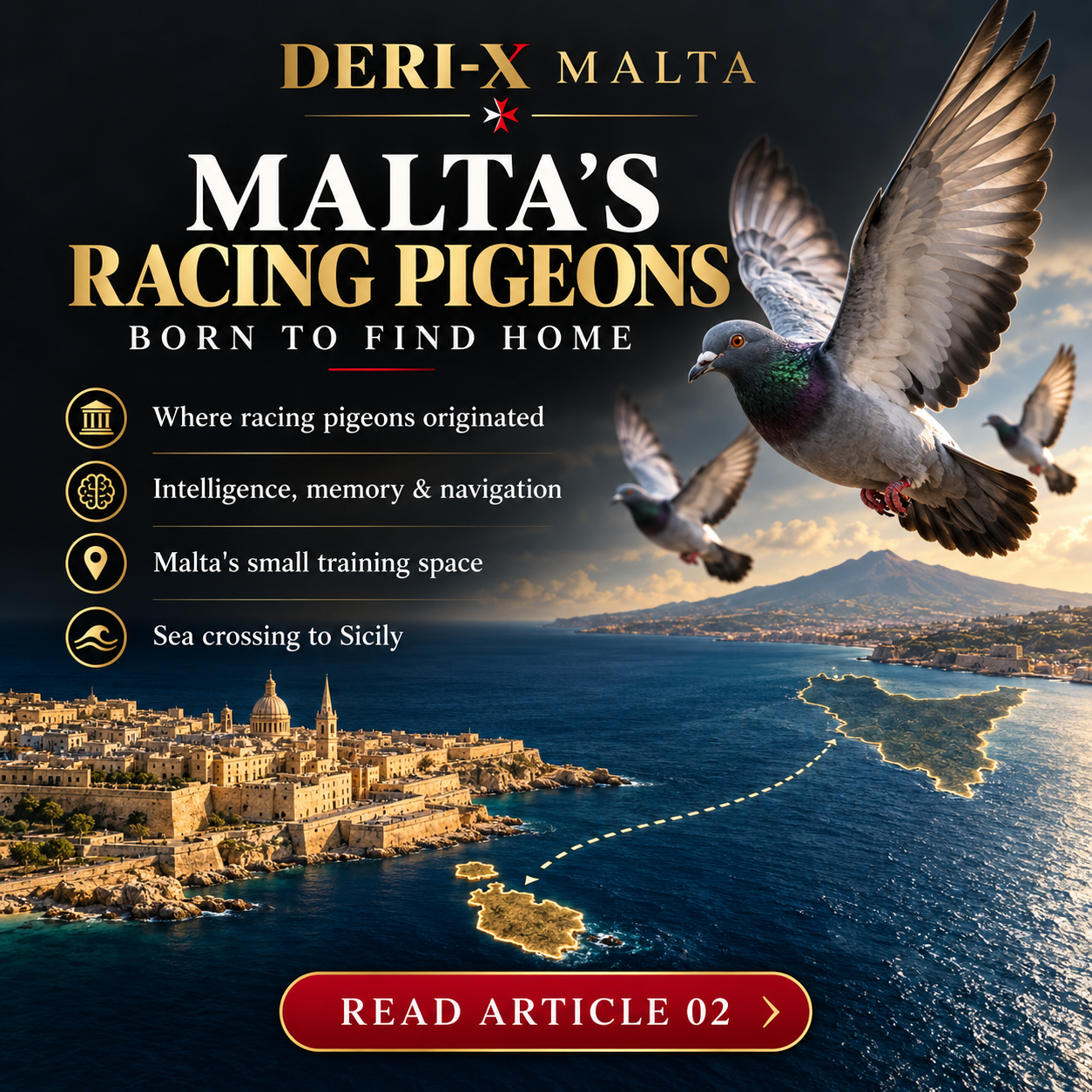
Malta gave it a Mediterranean character.
The racing pigeon did not appear as a completely new bird. It was developed over many generations from the domestic pigeon, whose wild ancestor is the rock dove (Columba livia). People recognised that certain pigeons had an exceptional ability to return home, even when released far away. By selecting and breeding birds for this quality, they gradually produced the fast, athletic and determined racing pigeon known today.
An ancient partnership with people
Humans have lived with and bred pigeons for thousands of years. Long before organised races, their homing ability made them valuable messengers. They carried news, commercial information and military messages across distances long before radio, telephones or the internet existed.
That long history matters because pigeon racing grew from something deeper than speed. It grew from people's fascination with a bird that could be taken away from its loft, released in unfamiliar country and still work out the way home.
Belgium and the birth of the modern sport
Modern competitive pigeon racing is generally traced to Belgium in the early nineteenth century. One widely recorded milestone is a Belgian long-distance race held in 1818 over approximately 160 kilometres.
As transport networks improved, pigeons could be carried to more distant release points. Clubs developed agreed rules, distances and timing systems, while fanciers bred families of birds for speed, endurance and homing ability. From Belgium the organised sport spread through France, the Netherlands, Britain and eventually much of the world.
An intelligent athlete
A racing pigeon does not return home by following one simple signal. Scientific research describes a flexible navigation system that can combine several kinds of information. Pigeons can learn visual landmarks, use the position of the sun as a compass, respond to magnetic information and build an understanding of place from environmental scents.
Close to home, experience and visual memory become especially important. A trained pigeon can recognise familiar routes and features of the landscape. It also learns the daily rhythm of its loft, its surroundings and its relationship with its fancier.
The racing pigeon is not simply a fast bird. It is an intelligent navigator with memory, learning ability and a powerful attachment to home.
Why Malta is different
In large continental countries, young pigeons can be trained gradually over land. A fancier may begin with a short release, then increase the distance step by step while still keeping the entire route above continuous countryside.
Malta does not offer that amount of land. The entire Maltese archipelago covers only 316 square kilometres. A short local training programme soon reaches the coast, whichever direction is chosen. This means Maltese fanciers have much less room to build distance using land releases alone.
Short first training, then a major step
Early training in Malta naturally begins with short local tosses. These help a pigeon gain confidence, learn the island and recognise the landscape around its home loft. Releases can then move towards the north of Malta and Gozo, but the possible land distance remains limited.
After that, the geography changes completely. The nearest point of Sicily is approximately 93 kilometres from Malta. To return from Sicily or mainland Italy, a racing pigeon must recognise its direction over a broad open channel and complete the final approach to a very small group of islands.
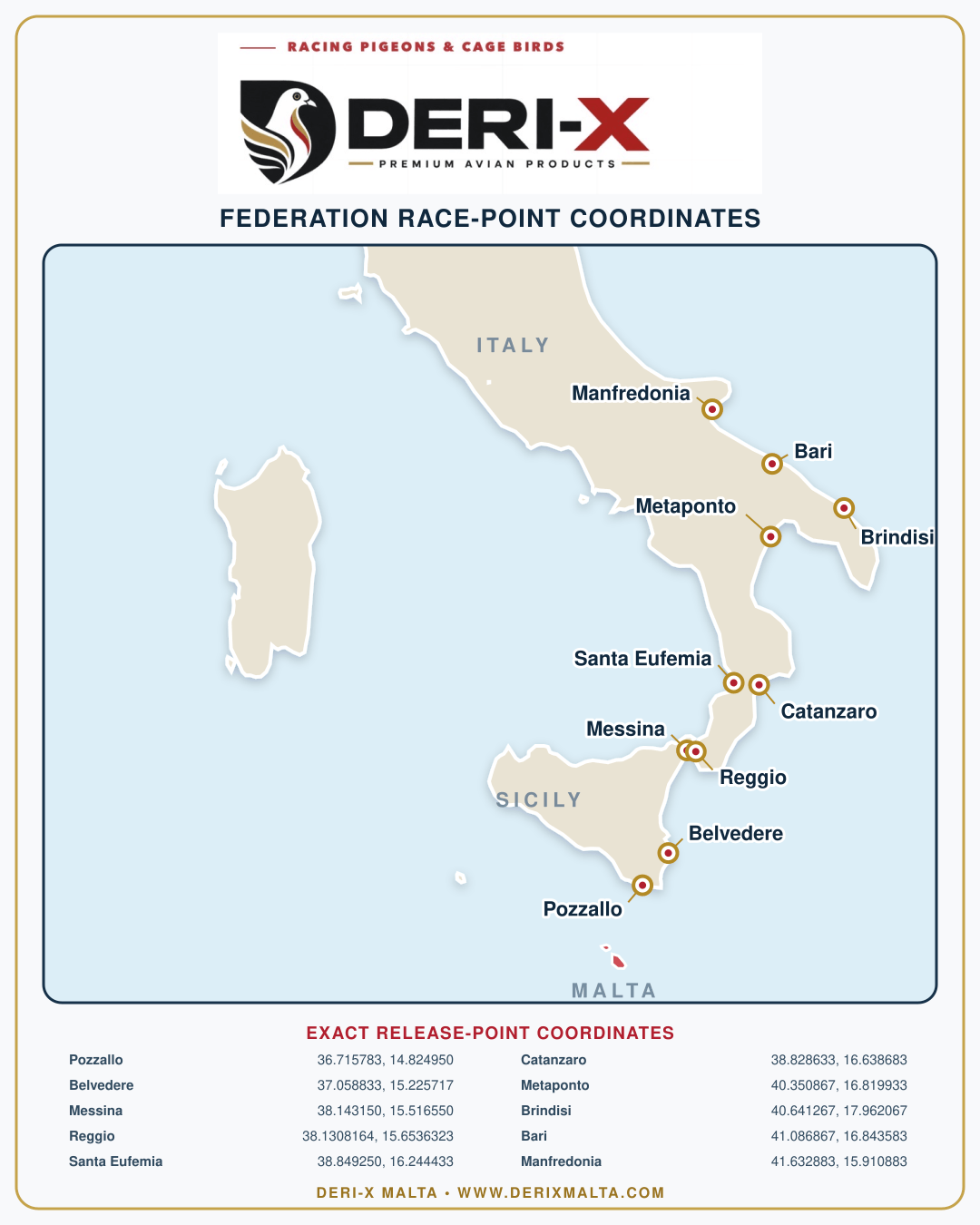
The Malta–Sicily channel
The sea channel is the feature that most clearly separates Maltese racing from the experience of many continental fanciers. Over land, a pigeon can use a continuous flow of roads, fields, towns and other familiar features. Over the channel, those visual references change dramatically.
Wind direction, visibility and the confidence to leave the coast can all influence the journey. The pigeon must commit to the crossing, keep its orientation and then locate Malta on the horizon. That is why a direct comparison based only on race distance does not always tell the whole story. A Maltese race has its own geography.
A small island, a precise home
Malta's small size creates another fascinating contrast. The island may be a tiny target after a long journey, but once a pigeon reaches familiar territory it can use its experience of the local landscape to find one particular loft among closely built towns and villages.
This combination—limited training land, an open-water return and a precise finish—has shaped the knowledge of Maltese fanciers. Observation, patience and gradual education are especially important. The aim is to help each pigeon build confidence in stages and fully understand where home is.
The same bird, a different test
Racing pigeons throughout the world share the same extraordinary qualities: intelligence, memory, speed, fitness and a desire to return to their loft. What changes from country to country is the route placed in front of them.
In Belgium, the Netherlands or Britain, the sport developed across large areas of connected land. In Malta, the island and the sea are part of every fancier's thinking. That does not make one form of racing better than another. It makes the Maltese experience distinctive—and gives every arrival over the island a special meaning.
References
- Veterinary Sciences: history and development of racing pigeons in Belgium
- Royal Pigeon Racing Association: pigeons through history
- Journal of Comparative Physiology A: cues indicating location in pigeon navigation
- Neurobiology of the homing pigeon: a scientific review
- Government of Malta: area and location of the Maltese Islands
Editorial note: The article distinguishes well-established historical and scientific findings from observations that follow directly from Malta's geography. It is intended as a positive introduction to the intelligence of the racing pigeon and the distinctive Maltese racing environment.
Loading comments…