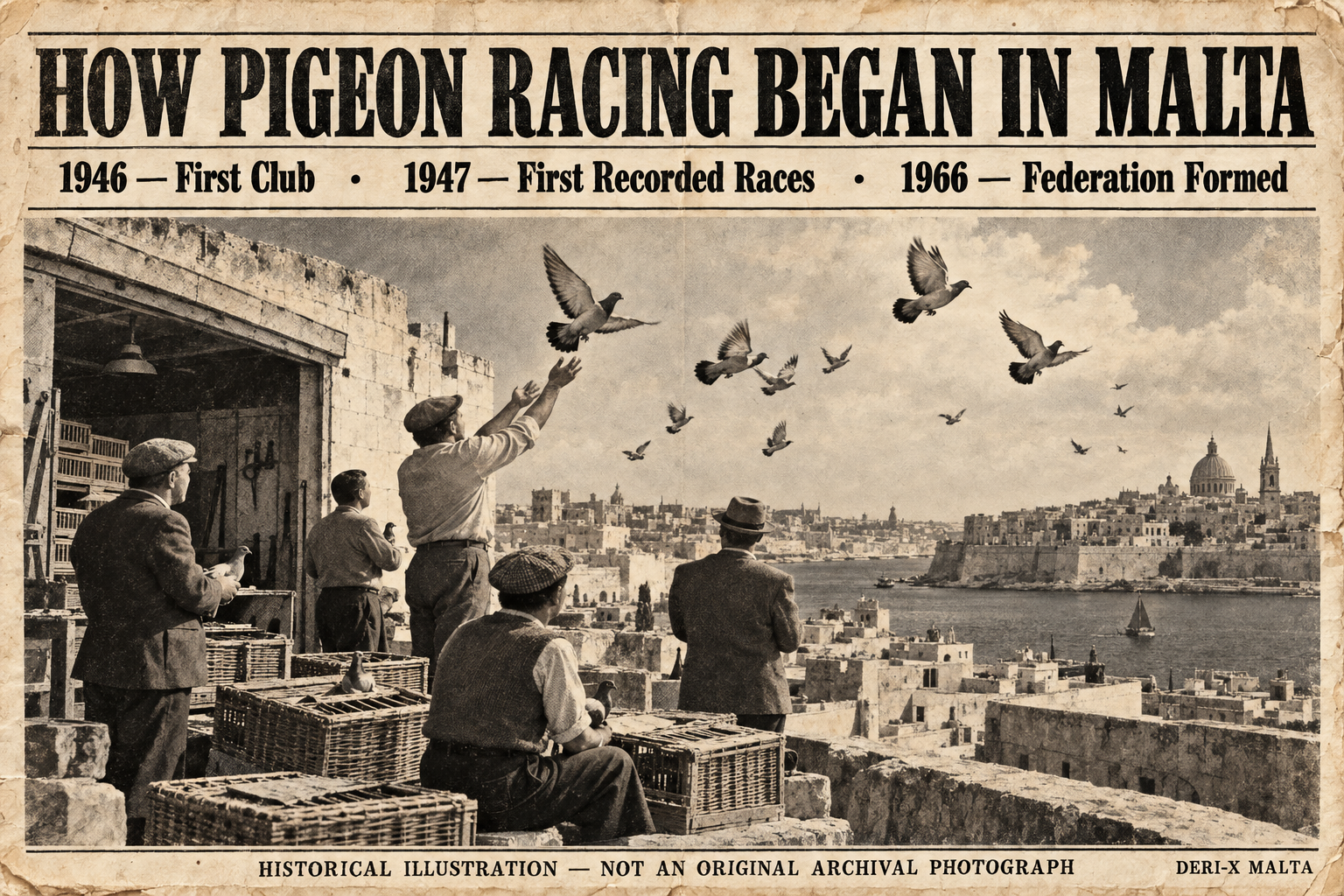
1947: first recorded races
Ask when pigeon racing started in Malta and you may hear different years mentioned—1946, 1947 and sometimes 1948. The clearest historical answer is that Malta's first racing pigeon club was officially established in 1946, while the first recorded races took place in 1947.
The story began immediately after the Second World War and was closely connected to the British military presence on the islands.
From military pigeons to racing birds
During the war, homing pigeons remained an important means of military communication. British military lofts operated in Malta, including at Luqa and Ta' Qali, and pigeons that had served during the war later helped form part of the foundation of the developing sport.
In late 1945, a group of British ex-servicemen living in Malta joined several Maltese pigeon enthusiasts to draw up the rules for a new club. Their intention was to transform their shared interest in homing pigeons into an organised competitive sport.
The club was named the Malta Racing Pigeon Club and was formally declared open in 1946. It was based in Sliema and initially had approximately 45 members.
Captain Reginald Cassar Torreggiani served as its first president, with Robert Apap as secretary and Joseph Pace as treasurer. British and Maltese enthusiasts worked side by side on the first committee—a collaboration that laid the foundations for organised pigeon racing in Malta.
Malta's first pigeon club had no clubhouse
In its earliest days, the club did not have permanent premises. Meetings, basketing, clock setting and clock checking were carried out in Captain Cassar Torreggiani's garage in Qui-Si-Sana, Sliema.
As interest grew, activities were also held in other garages around Sliema before the club eventually moved to premises at 48, Mrabat Street. These modest beginnings demonstrate how strongly the early members believed in the sport. They built it through voluntary work, cooperation and enthusiasm rather than elaborate facilities.
The first recorded races
An early training toss was organised from l-Aħrax tal-Mellieħa in 1945, even before the club was formally opened. Newspapers including The Times of Malta and Il-Berqa reportedly attended the occasion with photographers.
The first recorded races followed in 1947:
- Marfa
- San Lawrenz, Gozo
- Approximately 30 miles out at sea
- Approximately 35 miles out at sea
- Approximately 45 miles out at sea
1947 was the year organised pigeon racing truly began in practice, while 1946 remains the official founding year of Malta's first club.
The move to races from Sicily and Italy
The sport soon became more ambitious. The first recorded race from Syracuse was held on 27 January 1951, followed that year by races from Catania, Messina, Catanzaro and Metaponto. Brindisi was added in 1952.
These races gave the Maltese sport its unique character. Unlike most European racing pigeons, birds returning to Malta must complete the final part of their journey across open sea. The crossing between Sicily and Malta is approximately 93 kilometres, with nowhere for a tired pigeon to land and rest.
Transporting the birds was also demanding. In the early years, sealed wicker baskets were carried by hand to small boats, transferred to ships in the harbour and then taken to Sicily. Volunteers accompanied the pigeons, even when rough seas made the work difficult and dangerous.
The sport spreads across Malta
Membership of the original club continued to grow and eventually exceeded 150. Fanciers from other areas then began forming clubs closer to home.
The National Racing Pigeon Society opened in Marsa, followed by the Birkirkara Homing Union and the Hamrun Pigeon Club. Each club initially organised its own races, releases and results.
As more clubs were established, the need for a common governing body became clear. In 1966, the Federation of Pigeon Racing Clubs was formed. It introduced a shared racing programme, common basketing and timing procedures, and coordinated national results.
The Federation's first dedicated transporter began operating in 1973, replacing much of the difficult manual handling that had characterised the pioneering years.
An 80-year Maltese tradition
What began with a small group of British ex-servicemen and Maltese fanciers in a Sliema garage developed into one of Malta's most established specialist sports.
The equipment, transport and timing systems have changed enormously since those first races. However, the heart of pigeon racing remains the same: the care of the birds, patient preparation, faith in their homing ability and the unforgettable moment when a pigeon appears over its loft after a difficult journey home.
Every modern race from Italy to Malta carries part of the legacy created in 1946 and 1947 by the pioneers of Maltese pigeon racing.
Historical references
- Sliema Racing Pigeon Club historical account
- University of Malta Open Access Repository
- PIPA: Sliema Racing Pigeon Club
- Malta Federation of Racing Pigeons overview
- Times of Malta historical report
Historical note: Some secondary accounts state that the sport began in 1948. The detailed club history, Sliema club profile and University of Malta research support 1946 as the club's founding year and document races beginning in 1947.
Loading comments…